Mushroom Farming in Nepal: Complete Guide for Small Farmers
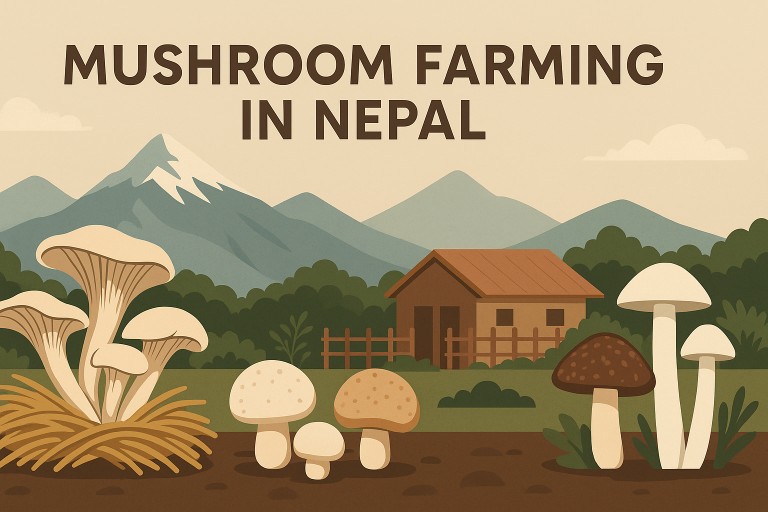
Mushroom (च्याउ) farming has quietly become one of the most profitable side-businesses in Nepal. It fits perfectly with our reality: small landholdings, cheap agricultural residues (khoilo, parali, bhus), youth looking for income in towns and villages, and growing demand from hotels, restaurants, and online grocery platforms.
This blog walks you through Nepal-focused mushroom farming: opportunities, best species, step-by-step cultivation, costs, markets, training, and challenges.
1. Why Mushroom Farming Makes Sense in Nepal
Low land requirement: You can start in a 10×12 ft room, shed, or unused space.
Use of waste materials: Paddy straw, wheat straw, maize cobs, sawdust, etc. – all easily available in Nepal’s agro system.
Fast returns: Oyster mushrooms can be harvested within 20–25 days of bag preparation.
Good market growth: Studies show mushroom production in Nepal increased about 8 times over a decade up to 2020, indicating rapidly growing demand.
Suitable climate zones: From Terai heat to cool mid-hills and high hills, different species can be matched to local climate.
In Nepal, most producers are small-scale farmers, and around 2,700+ rural households are engaged in mushroom production. Oyster mushrooms alone account for about 86% of total production, followed by white button (~10%) and shiitake (~2%).
2. Main Types of Mushrooms Grown in Nepal
2.1 Oyster Mushroom (कन्या च्याउ / Pleurotus spp.)
Most common & beginner-friendly
Grows on straw and agri-waste (parali, bhus, maize cob, sugarcane bagasse, etc.)
Tolerates a wide temperature range (18–28°C)
Can be grown in Terai, mid-hills, and even peri-urban Kathmandu inside simple rooms
Dominates Nepal’s mushroom industry (around 80–90% share)
Market price:
Online vegetable stores in Kathmandu list oyster mushrooms around Rs 250–300 per kg retail.
2.2 White Button Mushroom (गोब्रे च्याउ / Agaricus bisporus)
Needs cooler temperature (14–18°C) and controlled environment
Suitable for:
Cooler hill areas
Lowlands with insulated rooms + cooling
Higher investment than oyster (compost preparation, AC/insulation, racks, etc.)
Button mushroom prices in Kalimati market are often in the Rs 400–450/kg range.
2.3 Shiitake Mushroom (Lentinula edodes)
Premium mushroom with high market value
Grown on hardwood logs or sawdust blocks
Training projects in hills (e.g., Taplejung) have shown shiitake as a good option for high-altitude farmers.
2.4 Other Species
Straw mushroom – warm-climate mushroom suitable for Terai
Ganoderma/Reishi – medicinal mushroom, small niche but growing; some private labs in Bhaktapur and Kathmandu produce spawn and dried products.
For most beginners in Nepal, the smart path is:
Start with oyster, then add button or shiitake later when you gain skills and capital.
3. Matching Mushrooms to Nepal’s Climate Zones
You don’t always need costly climate control if you pick the right species for your area:
Terai & Inner Terai (Biratnagar, Janakpur, Bharatpur, Nepalgunj, etc.)
Summer: Very hot – good for oyster (warm-tolerant strains) and straw mushroom
Winter: Can try button in low-cost controlled units
Mid-Hills (Kathmandu, Pokhara, Butwal, Hetauda, Dharan, etc.)
Ideal for oyster year-round with minor adjustments (shade, fogging, or simple cooling)
Button possible with insulated rooms or tunnel houses
Shiitake on logs in cooler, moist microclimates
High-Hills (Dolakha, Ramechhap, Taplejung, Jumla, etc.)
Good for shiitake, oyster (cool strains), and potentially button with simpler systems
4. Key Inputs & Where to Get Them in Nepal
4.1 Spawn (Mushroom “Seed”)
Good spawn is the heart of successful mushroom farming.
Sources in Nepal include:
Research units like National Plant Pathology Research Centre (NPPRC), Khumaltar, which conduct spawn trials for Pleurotus, Agaricus, Calocybe, etc.
Private companies such as Mushroom Seed Nepal & Research Center, Bhaktapur, which produce spawn of oyster, shiitake, reishi, button, etc.
Other regional spawn labs and training centers (often linked to NARC, NGOs, and local governments).
Tip: Always buy from a reputed lab, ask for fresh spawn (recent manufacture date), and store it refrigerated until use.
4.2 Substrate (Growing Material)
Common, cheap substrates in Nepal:
Paddy straw (धानको पराल)
Wheat straw (गहुँको पराल)
Maize cobs & stalks
Sawdust (for shiitake, ganoderma)
Sugarcane bagasse in Terai
4.3 Infrastructure
For small-scale oyster farming, you need:
Simple room or shed (tin/CGI roof with insulation or thatch)
Racks or rope for hanging bags
Water sprayer or fogger
Thermometer and hygrometer (optional but helpful)
Plastic bags for substrate
For button/shiitake commercial scale, add:
Insulation (thermocol, double wall, etc.)
Cooling system or AC
Compost preparation area (for button)
5. Step-by-Step: Oyster Mushroom Farming in Nepal
Let’s focus on oyster, because it’s the best starting point.
Step 1: Plan Batch Size
For beginners:
Start with 50–100 bags.
Each bag (1.5–2 kg dry straw) can yield 1–1.5 kg fresh mushroom under good management.
Step 2: Prepare Straw
Chop straw into 3–5 inch pieces.
Pasteurize:
Boil water in a large drum.
Dip straw in 80–90°C hot water for 30–45 minutes (add a bit of lime if recommended by your trainer).
Drain well on a clean plastic sheet or net until the straw is moist but not dripping.
Step 3: Bag Filling & Spawning
Use transparent or milky polythene bags (approx. 12×18 or 14×20 inch).
Fill in layers:
First layer of straw
Sprinkle spawn evenly
Repeat (3–4 layers)
Close the bag with thread or rubber band.
Make small holes (pin holes) around the bag for air exchange.
Step 4: Incubation (Spawn Run)
Keep bags in a dark or dim room.
Temperature: 22–26°C ideally.
No need to spray much water yet – room humidity 70–80% is enough.
Within 10–14 days, the straw will turn white with mycelium.
Cleanliness is critical: even one contaminated bag can spread mold. Field stories from training programs in Nepal show that contamination during bag-making is one of the biggest causes of failure.
Step 5: Fruiting
Once bags are fully white:
Move them to a growing room with:
Indirect light (enough to read a book)
Humidity 80–90%
Good ventilation
Cut slits or remove the plastic from the sides so mushrooms can come out.
Spray water 2–3 times daily on walls & floor (not directly on young pins).
Within 5–7 days, small pinheads appear and grow quickly.
Step 6: Harvesting
Harvest clusters when caps are fully formed but not too flat.
Twist gently at the base instead of cutting too high (to avoid contamination).
Each bag can give 3–4 flushes over 3–4 weeks.
6. Example Economics: Small Oyster Unit in Nepal
Let’s assume a 100-bag oyster mushroom batch.
A. Costs (approximate)
Straw (200 kg @ Rs 8/kg) = Rs 1,600
Spawn (20–25 kg @ Rs 200–250/kg) ≈ Rs 4,500
Plastic bags, lime, fuel, etc. = Rs 1,000
Misc. (labour, electricity, rent share) ≈ Rs 2,000
Total cost ≈ Rs 9,000
B. Production
Avg yield: 1.0–1.2 kg per bag
Total yield: ~100–120 kg
C. Income
If you sell at Rs 280/kg (around current online rates for Kathmandu)
Revenue: 100–120 kg × 280 = Rs 28,000–33,600
D. Profit (per cycle of ~25 days)
Net profit ≈ Rs 19,000–24,000 per 100 bags
Scale that to 300–500 bags, and it becomes a very attractive monthly income if you manage continuous batches.
(Note: These are illustrative numbers; actual costs and prices vary by city, season, and market.)
7. Where to Learn & Get Training in Nepal
If you’re serious, hands-on training is highly recommended.
Some common sources:
Government & NARC-related centers
Units under Nepal Agricultural Research Council (NARC) and horticulture centers often conduct training or can connect you with experts.
NGOs & projects
Various rural livelihood and climate adaptation projects (e.g., trainings in Dhulikhel, Taplejung for shiitake) have promoted mushroom cultivation.
Private training centers
Private spawn labs and mushroom companies provide 2–3 day training packages on button, oyster, and shiitake cultivation, sometimes including enterprise guidance.
Ask your Municipality/Rural Municipality agriculture section; many local governments subsidize training and sometimes provide starter kits.
8. Marketing Mushrooms in the Nepali Context
You can sell:
Raw fresh mushrooms
Local vegetable vendors
Hotels & restaurants (Chinese, momo, thakali, Korean, etc.)
Online vegetable and grocery platforms in your city
Value-added products
Dried mushrooms – for off-season sale
Pickles (achar) – oyster/shiitake achar
Mushroom powder – for soups and health foods
Institutional buyers
Schools, hostels, hospitals (on contract)
Cooperatives and collection centers
Research from Nepal highlights that farmers often face middlemen and high cost problems and many lack proper training (only about 20% of surveyed mushroom farmers had formal training).
So, whenever possible, try to:
Build direct relationships with restaurants and retail shops
Use social media and local apps to sell directly to households
Work through cooperatives to negotiate better prices
9. Common Problems & How to Avoid Them
9.1 Contamination (मोल्ड लाग्ने समस्या)
Causes:
Dirty water or straw
Unclean hands, floor, or utensils
Over-wet substrate
Prevention:
Use clean straw and pasteurize properly
Work with washed hands, masks if possible
Keep incubation room relatively dry (no heavy spraying at this stage)
Contamination during bag preparation is repeatedly identified as a critical challenge by field trainers and projects in Nepal.
9.2 Temperature Stress
Very high summer temperatures in Terai & mid-hills can reduce yields.
Use:
Thick thatch or insulated roof
Foggers or frequent wall & floor spraying
Good ventilation and shading
9.3 Market Fluctuation
During peak season, prices drop.
Reduce risk by:
Drying a portion of your harvest
Having pre-agreed buyers (restaurants, hotels, cooperatives)
10. Advanced Paths: Scaling Up Your Mushroom Enterprise
Once you master small-scale oyster farming, you can:
Increase batch size gradually (100 → 300 → 500 bags).
Add new species:
Button in a separate controlled unit
Shiitake for higher-value markets (urban organic shops, hotels).
Move into value-added processing:
Dried mushrooms in branded packs
Mushroom achar and pickles
Powder for health mixes
Provide services:
Spawn distribution (after learning lab work)
Paid training in your local area
Buy-from-farmers & sell to city markets as an aggregator
MarketPlace
Mushroom can be sold or purchased online in nepal via marketplace platform like Sewapoint