Preservatives in Nepal’s Food Industry
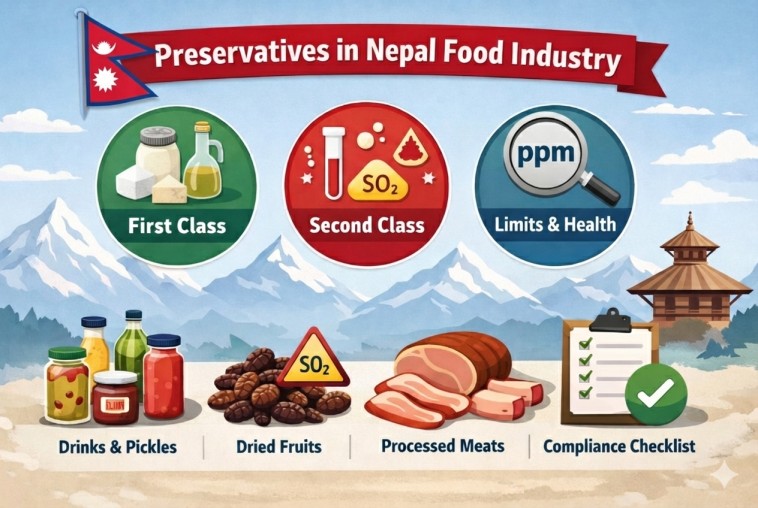
Types, Common Products, Legal Limits (ppm), and Health Effects (Nepal Food Rules, 2027 B.S.)
From home-based achar makers to commercial beverage and meat processors, Nepali food businesses use preservatives to keep products safe during storage and transport. Preservatives mainly help by:
Stopping microbes (bacteria, yeast, mold)
Reducing oxidation (rancidity, color loss)
Slowing enzymatic browning
This guide is written for students, entrepreneurs, and food manufacturers, and follows the preservative categories commonly cited from Nepal’s Food Rules, 2027 (B.S.).
1) Nepal’s key classification: First Class vs Second Class preservatives
A) First Class Preservatives (traditional / generally permitted)
Common in Nepali traditional food preservation:
Salt, sugar, glucose/dextrose, vinegar/acetic acid, spices, smoke, honey, alcohol, hops
Typical Nepali use-cases
Achar/pickles: salt + acidity (lemon/vinegar) + oil + hygiene
Jam/jelly: high sugar + heat (hot-fill) + clean packaging
Sukuti/smoked foods: drying + smoke + salt + moisture control
These methods work as multiple “hurdles” and often reduce the need for chemical preservatives.
B) Second Class Preservatives (regulated chemical preservatives)
Listed as second class (commonly referenced):
Benzoic acid and its salts (e.g., sodium benzoate)
Sulphur dioxide (SO₂) / sulphites
Sodium or potassium nitrites
Important Nepal rule: A food product should not contain more than one second class preservative.
2) What “ppm” means (so dosing stays legal)
Legal limits are usually given in ppm (parts per million).
1 ppm = 1 mg per kg of food
Example: 200 ppm = 200 mg/kg
For a 100 kg batch at 200 ppm:
200 mg/kg × 100 kg = 20,000 mg = 20 g
3) Benzoic acid / Sodium benzoate (best for acidic foods)
What it’s good for
Benzoates are strongest against yeast and some bacteria, especially when the food is acidic (low pH)—so they’re common in drinks and pickles.
Where it’s commonly used in Nepal
Non-alcoholic drinks / fruit drinks / lemon juice
Jams, marmalades, fruit jellies
Pickles and chutneys
Tomato sauces, ketchup-type products
Syrups and sherbets
Tomato puree/paste
Example maximum limits (as benzoic acid)
Drinks / fruit drinks / lemon juice: 600 ppm
Jam/marmalade/fruit jelly: 200 ppm
Pickles & chutneys: 250 ppm
Tomato and other sauces: 750 ppm
Tomato puree/paste: 250 ppm
Syrup & sherbets: 600 ppm
Health and formulation notes
Benzoates have an ADI (acceptable daily intake) concept used internationally.
In some beverages, benzoate + vitamin C (ascorbic acid) plus heat/light can (in certain conditions) form very small amounts of benzene. Manufacturers reduce risk by good formulation, minimizing metal contamination, and avoiding heat/light exposure.
Practical takeaway: Benzoate works well in acidic products—but only if pH is correct and ppm stays within limits.
4) Sulphur dioxide (SO₂) / Sulphites (browning control + shelf-life)
What it’s good for
Sulphites help control microbes and are especially useful for preventing browning and extending shelf-life in select foods.
Where it’s commonly used in Nepal
Non-alcoholic drinks / syrups / sherbets
Raisins/kismis and some dried products
Wine, beer, cider, fruit wines
Some dehydrated vegetables
Some jam/jelly/pickle categories (usually at lower limits)
Example maximum limits (SO₂)
Drinks / fruit drinks / lemon juice: 350 ppm
Jam/marmalade/fruit jelly/pickles: 40 ppm
Syrup & sherbets: 600 ppm
Raisins/kismis: 750 ppm
Wine: 450 ppm
Beer: 70 ppm
Health notes
Sulfite sensitivity occurs in some people (notably some with asthma). Reactions can include wheezing or allergy-like symptoms—so accurate dosing, testing, and labeling matter.
Practical takeaway: Powerful preservative, but higher sensitivity and compliance risk—use carefully and document well.
5) Nitrites (curing salts for processed meats)
What it’s good for
Nitrites help prevent dangerous bacteria (including botulism risk in certain cured meats) and provide cured color/flavor.
Where it’s used
Processed/cured meats such as ham and bacon (and similar categories)
Example maximum limit
Processed meats (including ham/bacon): nitrite ≤ 200 ppm
Health notes
Nitrites are tightly regulated globally. Overuse and frequent intake of certain processed meats is linked with long-term health concerns—so the key for manufacturers is strict ppm control and validated curing practices.
Practical takeaway: Useful for safety in cured meats, but dose control is non-negotiable.
6) Why products fail shelf-life in Nepal (even with preservatives)
Preservatives don’t fix poor processing. Common causes of spoilage include:
Poor hygiene during filling/packing
Wrong acidity/pH (e.g., benzoate fails if pH is too high)
Warm storage + high moisture (monsoon effect)
Weak packaging (leaks, oxygen entry, contamination)
No testing (micro tests, residue checks)
Best practice is multiple hurdles:
hygiene + heat process + correct pH + correct preservative + good packaging
7) Nepal-focused compliance checklist (quick)
Identify product category (drink, pickle, sauce, dried fruit, meat, etc.)
Confirm allowed preservative and max ppm for that category
Use only one second class preservative
Calculate ppm correctly (mg/kg) and keep batch records
Validate shelf-life using:
microbial testing
preservative residue testing
storage trials (summer + monsoon conditions)
Label honestly and maintain traceability
Quick reference (examples)
| Preservative (Second Class) | Best for | Example products | Example max limits |
|---|---|---|---|
| Benzoate (as benzoic acid) | Acidic foods | drinks, pickles, jams, sauces | 200–750 ppm (by category) |
| SO₂ / sulphites | Browning control + stability | raisins, drinks, wine, some dried foods | 40–750 ppm (by category) |
| Nitrites | Cured meat safety | ham, bacon-type products | up to 200 ppm |
Conclusion
In Nepal, safe shelf-life comes from science + discipline: selecting the right preservative, staying within ppm limits, controlling pH and hygiene, using good packaging, and validating with testing.
If you share your product types (e.g., achar, tomato sauce, juice/sherbet, jam, dried fruits, dairy, meat), I can rewrite this into a product-wise Nepal table with:
allowed preservative option
maximum ppm
pH/processing tips
common Nepal mistakes (summer/monsoon)
labeling + record-keeping checklist