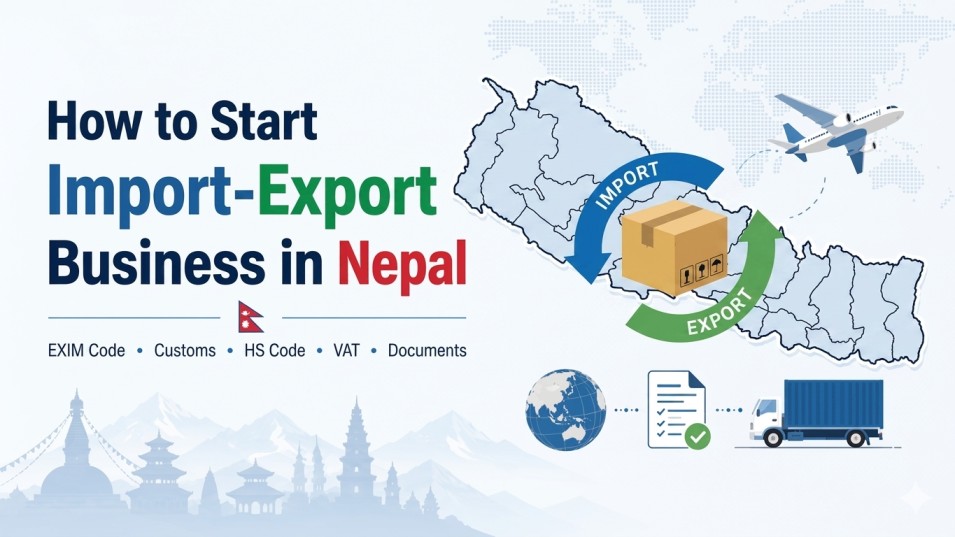
How to Start Import-Export Business in Nepal: Complete Practical Guide for Beginners and SMEs
Important Disclaimer
This article is a practical business guide, not legal, tax or customs advice. Import-export rules in Nepal change through the annual budget, Finance Act, customs notices, Nepal Rastra Bank circulars, product-specific directives and government decisions. Before making a shipment or payment, always verify the latest rule from the Department of Customs, Nepal National Single Window, Nepal Rastra Bank, Inland Revenue Department, your bank, your customs agent and the concerned product-regulating authority.
Introduction
Starting an import-export business in Nepal can look simple from the outside: find a supplier, pay them, bring goods into Nepal and sell them. Similarly, export may look like finding a foreign buyer and sending Nepali products abroad. But in practice, import-export is one of the most documentation-heavy business activities.
A small mistake in HS code, customs value, invoice, bank payment, product permit, food label, VAT entry, expiry date, foreign currency document or transit paper can delay clearance, increase cost, block goods at customs or create audit problems later.
For Nepal-based businesses, the main institutions usually involved are:
Department of Customs
Nepal National Single Window
Nepal Rastra Bank
Inland Revenue Department
Department of Food Technology and Quality Control for food-related goods
plant and animal quarantine authorities
Department of Drug Administration for medicine-related goods
Nepal Telecommunications Authority for telecom/wireless devices
banks, freight forwarders and customs agents
This guide is written for small businesses, ecommerce sellers, grocery traders, food businesses, manufacturers, distributors, exporters and new entrepreneurs who want to understand the full import-export process in Nepal.
1. What is Import-Export Business?
An import business means bringing goods from another country into Nepal for business purposes. This may include resale, distribution, manufacturing, repacking, ecommerce sale or use as raw material.
Examples of imports:
food and grocery products from India
packaging materials from China
machinery from Europe or China
cosmetics from Korea
ingredients from Thailand or India
electronics, spare parts or tools from abroad
An export business means selling goods or services from Nepal to foreign buyers.
Examples of exports:
tea, coffee, herbs and spices
pashmina and garments
handicrafts and handmade products
processed food products
carpets and wool products
software and IT services
agricultural products
Import-export business includes much more than buying and selling. It involves:
legal business registration
PAN/VAT registration
EXIM Code
HS code classification
product permits
bank payment documentation
customs declaration
tariff and tax calculation
transit and freight management
insurance
quality control
packaging and labeling
VAT and accounting
stock recordkeeping
audit preparation
The most important point is:
EXIM Code allows a trader to be identified as an importer/exporter, but it does not automatically allow every product to be imported or exported.
Some products need separate approval before import/export.
2. Basic Requirements to Start Import-Export Business in Nepal
Before starting commercial import/export, a business should prepare the following:
| Requirement | Purpose |
|---|---|
| Business registration | To legally operate as a company, firm, industry or other registered entity |
| PAN registration | Tax identification |
| VAT registration | Required if applicable under VAT law and useful for VAT credit/refund management |
| Business bank account | Needed for formal foreign payment and export realization |
| EXIM Code | Government identification for importer/exporter |
| Product permit if required | Needed for regulated goods such as food, plant, animal, medicine, telecom or chemical products |
| Customs agent or clearing agent | Helps with customs declaration and clearance |
| Freight forwarder or logistics partner | Helps with international transport and transit |
| Accounting and stock system | Needed for landed cost, VAT, stock, expiry and audit records |
For a serious commercial import-export business, do not start with only a supplier quotation. Start with a compliance file for each product.
3. What is EXIM Code in Nepal?
EXIM Code means Export Import Code. It is the registration code issued by the Department of Customs to identify importers and exporters.
In simple words:
EXIM Code is the official trader identification number used for import and export activities in Nepal.
It helps the government track registered importers and exporters. It is generally required for commercial import and export transactions.
However, EXIM Code is not the same as product approval. For example, even with EXIM Code, you may still need DFTQC approval for food items, quarantine approval for plant or animal products, drug authority approval for medicines, or telecom approval for certain wireless devices.
4. How to Apply for EXIM Code in Nepal
EXIM-related services are available through the Nepal National Single Window / EXIM service portal. The portal provides options such as applying for new EXIM, renewal, deregistration and reregistration.
A practical application process generally includes the following:
Step 1: Register the business
Before applying for EXIM, the business should be legally registered. Depending on your structure, this may be:
private firm
company
partnership firm
industry
cooperative or other eligible entity
Step 2: Prepare tax documents
You generally need PAN details. VAT registration may also be needed depending on your business size and nature of goods.
Step 3: Access the EXIM application portal
The EXIM application process usually asks for business PAN, personal PAN and email verification before proceeding with the application form.
Step 4: Fill business and tax information
The application may include:
business information
IRD/tax information
business registration details
owner/director details
contact information
bank-related information
required attachments
Step 5: Upload documents
Commonly required documents may include:
business registration certificate
PAN certificate
VAT certificate if applicable
owner/director citizenship or identification document
company documents if applying as a company
authority letter or board decision if someone applies on behalf of the company
tax clearance or renewal documents if requested
bank-related documents if requested
Requirements can change, so check the live EXIM portal or customs office before applying.
Step 6: Submit and wait for review
After submission, the application goes to the concerned customs office or authority for review.
Step 7: Receive EXIM Code
Once approved, the business can use the EXIM Code for import-export processes.
5. EXIM Code Cost, Bank Guarantee and Renewal
The EXIM portal lists both registration and renewal services. This means businesses should check their EXIM validity and renewal status regularly.
There have been policy discussions and customs notices related to the bank guarantee requirement for EXIM Code. Because this area has changed and official notices may be updated, businesses should not rely on old information. Before applying, confirm directly from:
Department of Customs
Nepal National Single Window / EXIM portal
concerned customs office
your bank
your customs agent
A good practice is to check EXIM status every fiscal year along with company renewal, tax clearance and VAT/PAN compliance.
6. Choosing the Right Product Before Importing or Exporting
Many beginners choose a product only because the foreign supplier price looks low. This is risky. The real question is not “How cheap is the supplier price?” but:
Can this product be legally imported/exported, cleared from customs, sold profitably and documented properly?
Before choosing a product, ask:
Is the product legally allowed for import/export?
Is it prohibited or restricted?
Does it need a permit, license or certificate?
What is the HS code?
What is the customs duty?
Is VAT applicable?
Is excise duty applicable?
Are there other fees or taxes?
Is the product perishable?
Does it have expiry date?
Does it need cold storage?
Does it need testing or lab report?
Is the label acceptable for Nepal?
Is the supplier genuine?
Is there trademark or brand authorization issue?
Is the product profitable after all costs?
For example, food products may need approval, inspection, testing and certification. Plant and animal products may need quarantine. Medicines may need drug authority approval. Telecom and wireless devices may need NTA-related approval.
7. Understanding HS Code in Nepal
HS Code stands for Harmonized System Code. It is an international product classification system used by customs authorities.
In Nepal, HS code affects:
customs duty
VAT
excise duty
additional charges
permit requirement
import/export restriction
customs valuation
trade statistics
eligibility for duty preference under trade agreements
Nepal’s tariff search tools allow traders to search products by HS code, chapter, keyword or commodity description.
Why HS Code is critical
A wrong HS code can cause:
wrong duty calculation
wrong VAT treatment
customs dispute
penalty risk
shipment delay
audit issue
wrong pricing decision
difficulty claiming VAT credit or refund
Do not depend only on the HS code given by the foreign supplier. A supplier’s HS code may be based on their country’s export classification, while Nepal customs may classify the item differently based on Nepal’s tariff schedule and product details.
HS classification can depend on:
product composition
ingredients
material
use
processing level
packaging
technical specifications
form of sale
product literature
lab test or inspection
Before importing a new item, confirm HS code with a customs agent and, for high-value or sensitive goods, consider seeking professional customs advice.
8. Customs Tariff, Duty, VAT and Other Charges
Customs tariff determines the duty and tax treatment of imported goods. Nepal publishes integrated tariff materials and tariff search tools, and these should be checked before every major shipment.
Possible import cost components include:
customs duty
VAT
excise duty
agriculture reform fee
health risk tax
infrastructure development tax
road construction fee
customs service charge
inspection or lab testing fee
port charge
terminal handling charge
customs agent fee
freight forwarder fee
bank charge
LC/TT/document charge
cargo insurance
container detention
port demurrage
warehouse rent
local transport
The tax and duty are affected by:
HS code
product description
country of origin
customs value
applicable trade agreement
product-specific law
annual Finance Act and tariff update
customs valuation rules
Because tariff and tax rules may change every fiscal year, businesses should not rely on old duty rates.
9. Customs Valuation: Why Invoice Price May Not Be Enough
Customs duty is usually calculated on customs value. The declared invoice value is important, but customs may question the declared value if it appears too low, inconsistent or unsupported.
Customs valuation may consider:
invoice value
freight
insurance
previous import values
price lists
manufacturer or distributor price
available market data
comparable goods
expert or agency information
If you receive a genuine discount from a supplier, keep evidence such as:
supplier quotation
email negotiation
sales contract
payment proof
product catalogue
discount explanation
grade/specification details
supplier price list
Avoid under-invoicing. It may reduce apparent customs value in the short term, but it creates serious customs, banking, tax and audit risk.
10. Landed Cost: The Real Cost of Importing
Landed cost means the total cost of bringing goods into your warehouse, ready to sell.
Many beginners calculate only:
Supplier price + freight + customs duty
This is incomplete.
A better formula is:
Landed Cost = Product Cost + Freight + Insurance + Customs Duty + VAT Impact + Excise + Other Taxes + Port/Terminal Charges + Agent Fee + Bank Charges + Testing Fee + Local Transport + Storage + Damage/Expiry Buffer
Example landed cost calculation
Suppose you import packaged food worth NPR 1,000,000.
| Cost item | Amount |
|---|---|
| Supplier invoice value | 1,000,000 |
| International freight | 80,000 |
| Insurance | 5,000 |
| Customs value | 1,085,000 |
| Customs duty, example 10% | 108,500 |
| VAT, example 13% on taxable base | 155,155 |
| Clearing agent fee | 15,000 |
| Local transport | 30,000 |
| Testing/permit reserve | 12,000 |
| Storage/cold-chain reserve | 20,000 |
| Total approximate cash outflow | 1,425,655 |
This is only an example. Actual duty, VAT, excise and fees depend on HS code and latest tariff rules.
If the import VAT is eligible as input credit, it may not be a final cost in the same way as customs duty. But it still affects cash flow because it must be paid at import and later adjusted or refunded according to VAT rules.
For business decisions, calculate:
total landed cost
VAT impact
cash-flow requirement
selling price
margin before tax
margin after expected damage/expiry
minimum profitable selling price
11. Product-Specific Permits and LPCO
Some products require LPCO, meaning License, Permit, Certificate or Other approval. Nepal National Single Window supports LPCO-related processes for different agencies.
Common regulated categories include:
| Product type | Possible concerned authority |
|---|---|
| Food and beverages | DFTQC / food authority |
| Plants, seeds and agricultural goods | Plant quarantine |
| Animal, meat and dairy products | Veterinary or livestock quarantine |
| Medicines | Department of Drug Administration |
| Telecom/wireless devices | Nepal Telecommunications Authority |
| Chemicals | Relevant ministry/department depending on chemical type |
| Alcohol/tobacco | Excise and other relevant authorities |
| Forest/herbal/protected items | Forest/CITES-related authorities |
| Cosmetics | Quality, health or product-specific rules may apply |
| Used goods/machinery | Product-specific restriction may apply |
The practical rule is:
Check permit requirements before the supplier ships the goods.
If goods arrive without the required permit, you may face delay, testing, storage cost, rejection, re-export or disposal.
12. Food Import Business in Nepal
Food import is one of the most sensitive categories because it affects public health. If you plan to import packaged food, snacks, spices, dry fruits, grains, frozen food, dairy products, meat products, beverages, ingredients or processed food, check DFTQC/food authority requirements before shipment.
Food import may require:
application
importer details
product details
brand name
exporting country
manufacturer/processor details
product label
quality certificate
lab analysis report or sample
inspection report
manufacturing license where applicable
export certificate where applicable
duplicate samples if required
Food import permission and inspection risk
Food import permission may have a validity period. Goods arriving at customs may be inspected and sampled. If the goods do not match the details submitted in the application, or if laboratory results fail to meet Nepal’s standards, clearance may be refused.
For food importers, the biggest practical risks are:
wrong or incomplete label
missing manufacturing date
missing expiry date
no batch number
ingredient mismatch
expired or near-expiry stock
product not matching test report
certificate from unreliable source
quality failure at customs testing
damaged packaging
no cold-chain arrangement
Food import checklist
Before shipping food items, check:
Is the product legally allowed?
Does it need DFTQC approval?
Is the label acceptable?
Is the ingredient list clear?
Is the manufacturing date visible?
Is expiry/best-before date visible?
Is the batch number printed?
Is country of origin shown?
Is manufacturer name/address shown?
Is net weight shown?
Is allergen information needed?
Is COA/lab report available?
Is shelf life enough after transit?
Does it need cold storage?
Is packaging strong enough?
For ecommerce and grocery businesses, shelf life matters a lot. A product may clear customs but become hard to sell if only a short expiry period remains.
13. Labeling Requirements: Why Labels Matter
Labeling is especially important for food, cosmetics, health products, chemicals and consumer goods.
A good import label should clearly show:
product name
brand name
manufacturer name and address
country of origin
net weight or volume
ingredients or composition
manufacturing date
expiry or best-before date
batch number
storage instruction
importer details if required
warning or caution if applicable
allergen declaration if applicable
MRP or price information where required
Common label problems include:
foreign-language-only label
no expiry date
no manufacturing date
no batch number
no ingredient list
wrong net weight
mismatch between label and invoice
product image different from actual goods
no country of origin
no manufacturer details
For regulated goods, label problems can delay clearance even when the product itself is genuine.
14. Foreign Payment for Import Business
Commercial import payment should be made through licensed banking channels under Nepal Rastra Bank rules. Payment rules can change, so your bank’s current checklist is very important.
Common international payment methods include:
| Payment method | Meaning | Practical use |
|---|---|---|
| Letter of Credit | Bank-backed payment against documents | Common for larger or third-country imports |
| Advance payment | Payment before shipment | Possible only if permitted by current bank/NRB rules and suitable for trusted suppliers |
| TT/remittance | Bank transfer | Depends on current rules, documents and product type |
| Documents against Payment | Documents released after payment | Used where bank/documentary collection is accepted |
| Documents against Acceptance | Buyer accepts payment obligation for future date | Used with supplier trust and bank acceptance |
| Open account | Supplier ships first and buyer pays later | Only for highly trusted relationships |
Older official transit guidance for third-country purchases emphasizes LC-based imports, especially CIF/C&F arrangements. In current practice, banks may allow different payment modes depending on Nepal Rastra Bank circulars, product type, value, margin requirement and documentation. Therefore, before confirming with a supplier, ask your bank:
Is this payment method allowed?
Is advance payment allowed for this product and amount?
Is LC required?
What margin is required?
What documents are required?
Which currency can be used?
Is the supplier country or product category sensitive?
Common currencies
Depending on supplier, country and bank approval, payment may be in:
INR for India trade
USD for third-country trade
CNY/RMB for some China trade
EUR, GBP, JPY or other convertible currencies where accepted
Do not use informal methods such as hundi, crypto, personal remittance or payment through unrelated third-party accounts. Informal payment can create problems in customs valuation, tax audit, banking compliance and supplier dispute.
15. Export Payment and Foreign Currency Realization
For export business, payment should come through formal banking channels.
Common export payment methods include:
advance payment
Letter of Credit
documentary collection
bank transfer under permitted rules
open account only with trusted buyers
For exports, customs and banks may require proof of advance payment or LC/documentary arrangement depending on the case. Exporters also need to track whether export proceeds are received in Nepal within the required period under foreign exchange rules.
Important export payment records include:
export invoice
bank certificate of advance payment or LC
buyer purchase order/contract
export declaration
foreign exchange declaration if required
payment realization certificate
short-payment explanation if any
buyer deduction details
credit note or refund note if applicable
For new foreign buyers, avoid shipping on open credit unless the buyer is verified and you can absorb the risk. Advance payment or LC is safer.
16. Transit Routes for Nepal Import and Export
Nepal is landlocked, so international trade often depends on transit through India, China or air cargo routes.
Common routes include:
India land route
Indian seaport plus land/rail transit to Nepal
China land route
air cargo through Nepal’s international airport customs
dry ports and inland clearance points
For third-country goods coming through Indian ports, documents and procedures may include customs transit documentation, bill of lading, commercial invoice, packing list, insurance, LC/bank documents and agent coordination.
Possible costs during transit include:
port charges
terminal handling charges
shipping line charges
container detention
demurrage
warehouse charges
rail or road freight
forwarding agent fee
customs agent fee
duty insurance or bank guarantee for sensitive goods where applicable
scanning/examination charges where applicable
truck waiting charges
Transit cargo generally should not be treated as normal import into the transit country, but it may still involve logistics and documentation costs. Do not assume “transit” means free movement without charges.
17. Land vs Air Import and Export
Land route
Land route is generally suitable for:
bulk goods
grocery and FMCG products
machinery
raw materials
low-margin goods
heavy shipments
regular commercial consignments
Advantages:
cheaper than air
suitable for larger volume
common for India and China trade
practical for regular supply chain
Disadvantages:
border delay
road disruption
weather risk
port demurrage
container detention
transit documentation
longer lead time
Air route
Air route is generally suitable for:
samples
urgent goods
high-value small goods
documents
electronics
perishable or time-sensitive goods
emergency stock
Advantages:
faster delivery
lower transit time
useful for urgent orders
suitable for small high-value items
Disadvantages:
expensive freight
airport storage cost
stricter air cargo requirements
margin pressure
not suitable for bulky low-margin goods
Choose land or air based on product value, weight, urgency, shelf life, margin and risk.
18. Do You Need a Customs Agent?
For most new importers and exporters, a customs clearing agent is strongly recommended.
A customs agent can help with:
customs declaration
HS code filing
document checking
duty/VAT calculation
permit coordination
customs examination
valuation discussion
clearance process
transit coordination
release of goods
However, do not depend blindly on an agent. The business owner remains responsible for the shipment, documents and tax records.
Ask your agent:
Which HS code will be used?
What is the duty and VAT rate?
Is excise or extra fee applicable?
Is LPCO/permit required?
What documents are missing?
What is the estimated total clearing cost?
What are possible delay points?
Will you provide customs declaration and payment receipt?
Are there any demurrage or detention risks?
A good agent reduces risk. A bad agent can create wrong classification, inflated charges, delays or weak records.
19. Import Documents Checklist
Documents vary depending on goods, route and payment method. Common import documents include:
| Document | Purpose |
|---|---|
| Proforma invoice | Used before order/payment/LC |
| Commercial invoice | Main trade and customs document |
| Packing list | Quantity, cartons, net/gross weight and package details |
| Bill of lading / airway bill / transport document | Transport evidence |
| Certificate of origin | Origin proof and possible tariff preference |
| Insurance document | Cargo risk and customs valuation |
| LC/TT/bank document | Payment proof |
| EXIM Code | Trader identification |
| PAN/VAT certificate | Tax identity |
| Product permit / LPCO | For regulated goods |
| COA or lab report | Food, chemical or quality evidence |
| DFTQC approval | For food products where required |
| Customs declaration | Official import filing |
| Duty/VAT payment receipt | Tax payment evidence |
| Transport receipt | Local delivery evidence |
All documents should be consistent. Product name, quantity, weight, value, supplier, consignee, route and country of origin should match across invoice, packing list, bank papers, transport document and customs declaration.
20. Export Documents Checklist
Common export documents include:
| Document | Purpose |
|---|---|
| Export invoice | Buyer and customs document |
| Packing list | Package, quantity and weight details |
| Customs export declaration | Official export filing |
| Certificate of origin | Required by many buyers/countries |
| Bank certificate of advance payment or LC | Payment evidence where required |
| Foreign exchange declaration | Banking/export realization record where required |
| Product-specific certificate | For food, plant, animal, medicine, handicraft or other regulated goods |
| Phytosanitary certificate | Plant/plant product export |
| Food quality certificate | Food export where required |
| Fumigation certificate | Certain agriculture/wood packaging exports |
| Airway bill / bill of lading / transport document | Shipment evidence |
| Insurance document | If required by Incoterms |
| VAT/export records | Tax and refund documentation |
Export documentation must satisfy both Nepal’s requirements and the importing country’s requirements.
21. Incoterms: Very Important for Import-Export
Incoterms define who is responsible for cost, freight, insurance, risk and delivery point.
Common Incoterms include:
| Incoterm | Meaning |
|---|---|
| EXW | Buyer handles almost everything from seller’s place |
| FOB | Seller delivers goods to port/ship; buyer handles main freight |
| CFR/CNF | Seller pays freight to destination port, insurance usually buyer’s responsibility |
| CIF | Seller pays freight and insurance to destination port |
| DAP | Seller delivers to agreed place; import duty/tax usually buyer’s responsibility |
| DDP | Seller delivers including duty/tax; complicated and risky for Nepal unless very clearly arranged |
Many disputes happen because buyers think “shipping included” means everything is included. But the supplier may mean freight only up to an Indian port, Chinese border, airport or another point.
Before confirming order, ask:
What is the Incoterm?
Where does risk transfer?
Who pays international freight?
Who pays insurance?
Who pays destination port/terminal charges?
Who handles Nepal customs clearance?
Who pays customs duty and VAT?
Who pays local delivery to warehouse?
22. VAT in Import-Export Business
VAT is very important in Nepal import-export business.
In import, VAT may be collected at customs if the goods are VATable. If the business is VAT registered and the purchase is used for taxable business, import VAT may generally be treated as input tax credit according to VAT law and documentation requirements.
In export, exports are generally handled under the zero-rating framework when conditions are met. This can allow eligible exporters to claim refund or adjustment of input VAT, but only with proper documents and verification.
For VAT management, keep:
customs declaration
import VAT payment receipt
commercial invoice
purchase records
sales VAT bills
stock register
export invoice
export customs declaration
bank realization proof
VAT returns
reconciliation sheets
Common VAT problems include:
missing purchase entry
invalid supplier bill
customs document not recorded
stock not matching sales
export payment not received through bank
export invoice not matching customs declaration
mixing VATable and VAT-exempt goods without proper accounting
weak link between purchases and exported goods
For mixed taxable and exempt goods, consult an auditor before large imports.
23. VAT Refund on Export
Exporters may be eligible for VAT refund when input VAT is linked to zero-rated export sales, subject to VAT law and IRD verification.
A good VAT refund file should include:
export invoice
customs export declaration
packing list
transport document
certificate of origin if applicable
bank payment realization certificate
purchase VAT bills
import VAT documents if imported input was used
stock register
production records if goods are manufactured
VAT return copies
reconciliation sheet linking input to export
The biggest issue in VAT refund is mismatch. Your purchase, stock, production, export, customs and bank records should support the same transaction story.
Do not wait until refund time to organize documents. Prepare the refund file shipment by shipment.
24. Export Return and Refund to Foreign Buyer
Sometimes exported goods may be returned due to:
quality problem
wrong specification
damaged goods
failed lab test
buyer rejection
wrong shipment
mismatch with contract
accident or natural disaster during transport
If exported goods come back to Nepal, handle it through customs and bank documentation. Do not manage it informally.
For export return, keep:
original export declaration
export invoice
packing list
transport document
buyer rejection letter
reason for return
proof that returned goods are the same exported goods
re-import customs document
bank payment record
credit note or refund note
product inspection report if available
If payment was already received and you need to refund the foreign buyer, apply through your bank with proper documents. Informal refund can create foreign exchange, tax and audit problems.
25. Import Return to Foreign Supplier
Imported goods may need to be returned due to:
wrong goods
damaged goods
inferior quality
expired or near-expiry goods
short shipment
failed inspection
mismatch with contract
supplier error
For import return, keep:
original import declaration
customs duty/VAT receipt
supplier complaint communication
return agreement
debit note or credit note
re-export document
transport document
insurance claim if applicable
replacement shipment documents if goods are replaced
If customs duty or VAT was already paid, refund or adjustment depends on the law, timing, evidence and decision of the concerned authority. Handle this with a customs agent and tax consultant.
26. Supplier Verification for Importers
Before paying a foreign supplier, verify them carefully.
Check:
company registration
export license if relevant
website and business history
factory or warehouse evidence
product sample
product certificate
certificate of analysis if applicable
bank account name matching supplier company
platform reviews if using B2B marketplace
previous export experience
ability to provide correct invoice and packing list
willingness to provide inspection before shipment
Avoid:
payment to personal bank account
supplier refusing video call
supplier refusing sample
unrealistically cheap price
no company documentation
supplier changing product specification after payment
invoice from one company but payment to another company
For first shipment, order a trial quantity rather than a large shipment.
27. Buyer Verification for Exporters
Before exporting to a foreign buyer, verify the buyer.
Check:
company registration
website and business identity
import license if needed in their country
bank details
previous trade history
buyer’s ability to clear goods in destination country
requested payment term
whether their purchase order looks genuine
whether the destination country allows the product
For new buyers, prefer:
advance payment
LC
partial advance with secure balance arrangement
Be careful with fake buyers who send large purchase orders but avoid advance payment or request unusual charges.
28. Quality Control and Pre-Shipment Inspection
Quality control should be done before shipment, not after goods arrive.
For imports, check:
product sample
specification sheet
packaging
label
carton marking
net/gross weight
quantity
batch number
manufacturing/expiry date
certificate and test report
photos/videos of actual shipment
loading inspection for larger orders
For exports, check:
buyer specification
packaging strength
labeling requirement
destination country rules
moisture, contamination or pest risk
required certificates
product consistency
weight and carton count
For food, also consider:
microbial test
pesticide residue
moisture content
allergen declaration
storage condition
shelf-life certificate
COA
29. Insurance in Import and Export
Cargo insurance protects against damage, theft, accident and other transit risks. Many small businesses skip insurance to save cost, but this can be risky.
Insurance is especially important for:
expensive goods
electronics
machinery
fragile goods
food products
frozen or chilled goods
sea cargo
long-route transit
bulk shipments
For insurance claims, usually keep:
insurance policy
invoice
packing list
transport document
damage report
photos/videos
survey report
customs document
claim letter
If you do not have insurance, you may have to absorb the full loss yourself.
30. Common Problems in Import Business in Nepal
1. Wrong HS code
Wrong classification can create duty, VAT, permit and customs dispute.
2. Underestimated landed cost
Businesses often forget bank charges, demurrage, testing, storage, transport, insurance and damage loss.
3. Missing permit
Food, plant, animal, medicine, telecom and controlled goods may stop at customs without approval.
4. Supplier sends wrong goods
This is common when supplier verification is weak.
5. Label problem
Missing expiry date, batch number, ingredients or country of origin can delay clearance.
6. Customs valuation dispute
Under-invoicing or unsupported low value can create customs problems.
7. Bank payment delay
Banks may require additional documents, margin or clarification.
8. Demurrage and detention
Delay at port, border or customs can become very expensive.
9. Expiry and shelf-life loss
For food and FMCG, delay reduces saleable life.
10. Weak accounting
If customs, bank, purchase, VAT and stock records do not match, audit becomes risky.
31. Common Problems in Export Business in Nepal
1. Buyer does not pay on time
Use advance payment or LC for new buyers.
2. Buyer rejects goods
Quality, packaging, certificate and labeling should be agreed before shipment.
3. Missing certificate
Destination country may require certificate of origin, phytosanitary certificate, food certificate, fumigation certificate or lab report.
4. Poor packaging
Export goods may travel long distances and can be damaged if packaging is weak.
5. Wrong Incoterms
Unclear freight, insurance or destination charges can create disputes.
6. VAT refund delay
Refund may be delayed if documents do not reconcile.
7. Export proceeds not realized properly
Foreign payment should be tracked through bank documentation.
32. Recordkeeping System for Import-Export Business
Every shipment should have a separate digital folder.
Example:
Imports/
  2082-83/
    SupplierName-Shipment-01/
      01-Proforma-Invoice.pdf
      02-Bank-Payment-or-LC.pdf
      03-Commercial-Invoice.pdf
      04-Packing-List.pdf
      05-BL-or-AWB.pdf
      06-Certificate-of-Origin.pdf
      07-Insurance.pdf
      08-Permit-or-LPCO.pdf
      09-Customs-Declaration.pdf
      10-Duty-VAT-Receipt.pdf
      11-Landed-Cost-Sheet.xlsx
      12-Stock-Entry.xlsx
For exports:
Exports/
  2082-83/
    BuyerName-Shipment-01/
      01-Purchase-Order.pdf
      02-Export-Invoice.pdf
      03-Packing-List.pdf
      04-Certificate-of-Origin.pdf
      05-Product-Certificate.pdf
      06-Bank-Advance-or-LC.pdf
      07-Customs-Export-Declaration.pdf
      08-BL-or-AWB.pdf
      09-Payment-Realization.pdf
      10-VAT-Refund-File.xlsx
For food or perishable goods, also maintain:
batch number
manufacturing date
expiry date
quantity imported
quantity sold
damaged quantity
returned quantity
remaining stock
customer complaints
supplier claims
Good records help during customs audit, tax audit, VAT refund, supplier dispute and insurance claim.
33. Recent Changes and Updates Businesses Should Watch
Import-export rules in Nepal can change frequently. Businesses should monitor:
1. Customs Act and Customs Regulation
Nepal has recent customs law and regulation updates. Businesses should check the latest Customs Act, Customs Regulation and customs notices before major shipment decisions.
2. Guidance on detailed goods declaration
Customs has issued guidance related to declaring detailed goods information. This means traders should describe goods clearly and accurately instead of using vague names.
3. EXIM bank guarantee and renewal notices
There have been customs notices related to EXIM Code and bank guarantee. Since rules have changed over time, verify directly from the Department of Customs or EXIM portal before applying.
4. Integrated tariff updates
Tariff, VAT, excise and other charges may change with the annual budget and Finance Act. Check current tariff before importing.
5. NRB foreign exchange circulars
Foreign payment, LC margin, advance payment and export realization rules may change through Nepal Rastra Bank circulars. Always ask your bank for the latest checklist.
6. Product-specific rules
Food, plant, animal, medicine, telecom, chemical and other regulated goods may have separate updates from concerned authorities.
34. Step-by-Step Guide to Start Import Business in Nepal
Step 1: Register your business
Choose the proper structure: company, firm, partnership or industry.
Step 2: Get PAN/VAT registration
PAN is basic tax identity. VAT registration depends on your business nature and legal threshold.
Step 3: Get EXIM Code
Apply through the official EXIM/NNSW system.
Step 4: Select product carefully
Check demand, profitability, shelf life, restrictions and permits.
Step 5: Identify HS code
Use tariff search tools and confirm with a customs professional.
Step 6: Check duty, VAT and other charges
Do not calculate profit without tariff and landed cost.
Step 7: Check product permit
Confirm DFTQC, quarantine, drug, telecom or other approval if needed.
Step 8: Verify supplier
Check supplier legitimacy, sample, quality and bank account.
Step 9: Confirm payment method with bank
Ask your bank what payment mode is allowed and what documents are required.
Step 10: Confirm Incoterms
Clarify EXW, FOB, CFR/CNF, CIF, DAP or other terms.
Step 11: Arrange freight and insurance
Choose land, sea-transit or air route based on product and cost.
Step 12: Check documents before shipment
Invoice, packing list, label, permit, certificate and transport details should be correct before dispatch.
Step 13: Customs clearance
Your agent files declaration, coordinates inspection and arranges duty/VAT payment.
Step 14: Receive goods and enter stock
Check quantity, condition, batch and expiry.
Step 15: Maintain accounting records
Record purchase, import VAT, customs duty, landed cost, stock and sales correctly.
35. Step-by-Step Guide to Start Export Business in Nepal
Step 1: Select export product
Check quality, demand, packaging and destination-country requirement.
Step 2: Verify buyer
Confirm buyer identity, payment ability and import capacity.
Step 3: Confirm payment terms
Prefer advance payment or LC for first transactions.
Step 4: Check destination country rules
Nepal export clearance is not enough. Buyer country may need import license, label, lab test or certificate.
Step 5: Prepare product and packaging
Use export-standard packaging.
Step 6: Arrange certificates
Certificate of origin, phytosanitary, food quality certificate, fumigation or other certificate may be required.
Step 7: Prepare export documents
Invoice, packing list, bank certificate/LC, customs declaration and transport document.
Step 8: Customs clearance
Submit export declaration and supporting documents.
Step 9: Ship goods
Use land, air or sea-transit route depending on buyer and product.
Step 10: Track payment realization
Make sure foreign currency is received through banking channel.
Step 11: Prepare VAT refund file if eligible
Keep documents organized from the beginning.
36. Practical Checklist Before Importing
| Question | Yes/No |
|---|---|
| Is business registration active? | |
| Is PAN/VAT status clear? | |
| Is EXIM Code active? | |
| Is HS code confirmed? | |
| Is customs duty checked? | |
| Is VAT/excise checked? | |
| Is product legally allowed? | |
| Is permit/LPCO required? | |
| Is supplier verified? | |
| Is product label checked? | |
| Is shelf life enough? | |
| Is payment method approved by bank? | |
| Is Incoterm clear? | |
| Is landed cost calculated? | |
| Is agent selected? | |
| Is insurance arranged? | |
| Are documents ready before shipment? | |
| Is stock/accounting system ready? |
37. Practical Checklist Before Exporting
| Question | Yes/No |
|---|---|
| Is buyer verified? | |
| Is payment secured? | |
| Is destination country requirement checked? | |
| Is HS code confirmed? | |
| Is certificate of origin needed? | |
| Is product-specific certificate needed? | |
| Is packaging export-quality? | |
| Is invoice prepared? | |
| Is packing list prepared? | |
| Is bank certificate/LC ready? | |
| Is customs declaration ready? | |
| Is transport booked? | |
| Is export payment tracking system ready? | |
| Is VAT refund file planned? |
38. Best Advice for New Import-Export Businesses in Nepal
If you are starting import-export business in Nepal, do not begin with a very large shipment. Start small, learn the process, create records and build reliable relationships.
The most important rules are:
1. Confirm HS code before ordering
HS code controls duty, VAT, permits and restrictions.
2. Check permit before shipment
Do not ship regulated goods without approval.
3. Pay through legal banking channel
Avoid informal payment methods.
4. Calculate real landed cost
Profit is decided by landed cost, not supplier price.
5. Keep audit-quality records
Customs, bank, VAT, stock and sales records should match.
6. Verify supplier and buyer
Most trade losses happen because trust was given too early.
7. Protect shelf life and quality
For food, grocery and FMCG, delay and expiry can destroy profit.
8. Stay updated
Rules can change after budget, customs notices and NRB circulars.
Conclusion
Import-export business in Nepal can be profitable, but it requires careful preparation and disciplined documentation. The biggest mistake beginners make is thinking that import-export is only about buying goods from abroad and clearing customs. In reality, it is a complete system involving business registration, EXIM Code, HS code, tariff, permits, foreign payment, customs declaration, VAT, transit, quality control, insurance and recordkeeping.
For importers, the most important steps are product selection, HS code confirmation, permit checking, supplier verification, legal bank payment, landed cost calculation and customs documentation.
For exporters, the most important steps are buyer verification, payment security, product quality, destination-country compliance, export documents, foreign currency realization and VAT refund records.
A business that keeps proper documents, uses correct HS codes, follows bank and customs rules, checks product permits before shipment and calculates landed cost accurately will have a much better chance of succeeding in Nepal’s import-export sector.
The safest approach is simple:
Verify first, ship later. Document everything. Keep customs, bank, VAT and stock records consistent.