Honey Farming in Nepal
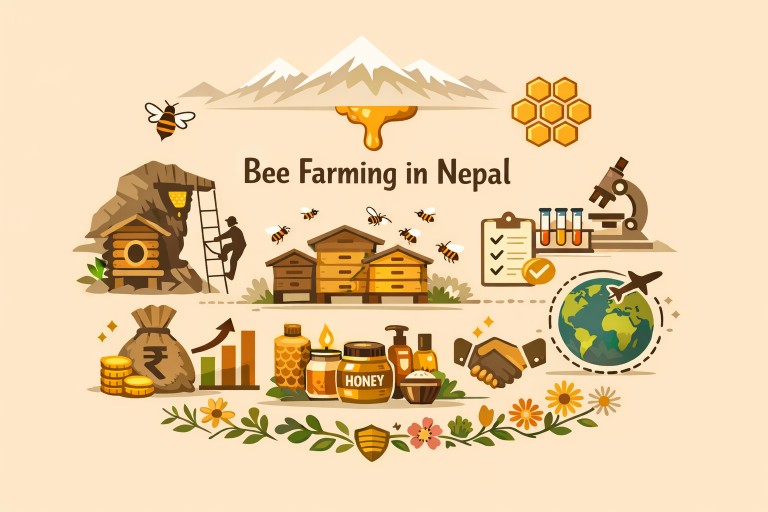
Honey farming (beekeeping / apiculture) in Nepal ranges from traditional hill beekeeping with Apis cerana to commercial Terai operations using Apis mellifera, plus wild cliff honey harvesting from Apis laboriosa (“mad honey”). Done well, it can be a strong side-income, improve crop yields through pollination, and create additional products like beeswax and propolis.
This single, organized blog combines everything from the earlier notes—now structured as one practical guide.
1) “Types of honey” in Nepal (3 meanings people use)
A) Types by bee species (most important for farming)
Nepal has multiple honeybee species, but for managed beekeeping, these two dominate:
Apis cerana (Asian hive bee)
Best suited to hills and mid-hills; commonly kept in traditional log/wall hives or improved hives. Typically lower yield per colony than mellifera, but often hardy and locally adapted.Apis mellifera (European/Western honeybee)
Common in Terai and accessible mid-hills with strong forage and good management. Higher production potential, but more management-sensitive (pests/diseases, feeding discipline, migration planning).
Wild species (generally not farmed in boxes) include Apis dorsata and Apis laboriosa (cliff bees), the latter linked with “mad honey.”
B) Types by floral source (what customers recognize)
Customers often buy by “flower name.” In Nepal, you’ll commonly hear:
Mustard honey (Terai / inner-Terai)
Chiuri honey (mid-hills—strong identity product)
Buckwheat honey (higher hills pockets)
Forest / multi-floral honey (common across regions)
C) Types by processing / quality positioning
Raw / unheated (strained): premium positioning, needs strict hygiene + moisture control
Extracted (centrifuged): standard for frame hives
Comb honey: niche premium if done cleanly
Mad honey: specialty product; requires careful labeling and responsible sourcing
2) Choosing the right “way” to keep bees (systems that fit Nepal)
Way 1: Traditional low-cost (log hive / wall hive) — mainly Apis cerana
Best for: hillside villages, low-investment start, learning phase
Pros: low cost, locally adapted
Cons: harder inspection & disease control; uneven harvest/quality; lower yields
Way 2: Improved / semi-modern (improved cerana hive, top-bar)
Best for: people who want better management without full commercial cost
Pros: easier inspection than logs; better hygiene and harvesting
Cons: needs skills; materials and design quality matter
Way 3: Commercial modern (Langstroth/Newton) — usually Apis mellifera
Best for: Terai, peri-urban commercial supply chains, scaling volume
Pros: higher yield potential; standardized extraction
Cons: higher upfront cost; more disease/pest management; migration logistics
3) Where to place an apiary (site selection that actually works)
Use this 5-point checklist before you buy hives:
Forage within 1–3 km: farms, forests, orchards, mustard fields, chiuri belts, buckwheat areas
Morning sun + afternoon shade: helps activity; reduces overheating
Wind protection: hedges/fences reduce stress and drifting
Reliable water: shallow water with stones/wood for landing
Human safety: away from schools, paths, neighbor doors, and livestock pressure
Migration (moving hives) = big yield booster (if you can manage it)
Commercial beekeepers often move colonies following blooms (e.g., mustard → fruit blossoms → sunflower/forest flow). Migration improves yield but increases costs and requires agreements and transport planning.
4) Seasonal management (simple logic that fits every district)
Nepal’s flowering comes in strong nectar “flows” and dearth periods.
Flow season (nectar coming):
add space (supers), prevent swarming, keep colonies strong, harvest only ripe honeyDearth season (little forage):
reduce hive space, monitor pests, feed only if needed, avoid weakening colonies
Your best move is to build a local bloom calendar by asking farmers and orchard owners within your 3 km forage radius.
5) Practical tips that save beginners (most losses are management mistakes)
A) Start small, but start with quality colonies
Start with 2–5 colonies, not 20. Choose colonies with:
good brood pattern,
active foraging,
calm temperament,
low visible disease/pest signs,
adequate stores.
B) Swarm control (the #1 “I lost my bees” reason)
Swarming is often caused by overcrowding, heat, old queen, or lack of space.
Do this early:
add frames/supers before congestion,
improve ventilation/shade,
split colonies if you know the method or get a trained person to help.
C) Feeding discipline (don’t destroy trust)
Feed only:
during dearth,
for new splits,
to support comb-building.
Avoid feeding during honey flow—customers (and labs) can detect problems, and your brand reputation suffers.
D) Hygiene
Keep apiary clean; manage deadouts properly
Avoid spilling honey (triggers robbing/ants)
Store frames and equipment carefully (wax moth risk)
6) Harvesting & processing (quality is your real “marketing”)
Harvest only ripe honey
Prefer frames that are mostly capped (sealed by bees).
Unripe honey = higher moisture = fermentation risk.
Moisture + heat + storage = your quality triangle
Overheating increases quality damage markers like HMF. The global Codex honey standard sets HMF ≤ 40 mg/kg for honey after processing/blending (with a higher allowance for tropical-origin cases).
Practical takeaway: keep extraction clean, avoid overheating, store airtight in food-grade containers away from sun/heat.
7) Training in Nepal: where to learn (and what training must cover)
Main public training hub
Apiculture Development Centre runs beekeeping trainings including basic training, hive training, and 15-day ToT-style programs as listed in its training and work execution pages.
Other training ecosystem (useful to watch)
Nepal is also hosting an International Beekeeping Conference in April 2026 in Chitwan, jointly involving Agriculture and Forestry University and Ministry of Agriculture and Livestock Development partners (good place to network and learn modern practices).
What good training should include (non-negotiables)
choosing cerana vs mellifera for your geography
inspection routine + brood reading + queen quality
swarm control + splitting
feeding rules (dearth only)
varroa/wax moth basics; safe treatments
harvesting ripe honey + extraction hygiene + moisture control
records: batch, date, location, feeding log
8) Cost of investment & income: realistic Nepal benchmarks (numbers you can cite)
Yield, cost, profit (Chitwan benchmark)
A study on honey production economics in Chitwan reported: ~23.71 kg/hive/year average productivity, ~NRs 4,746.62 production cost per hive, and ~NRs 3,270.01 profit per hive (annual).
Yield benchmark (Dang, mellifera)
A Nepal journal study reported ~23.5 kg/hive/year productivity for Apis mellifera (2019/20 context) with marketing channel insights.
Profit benchmark (Dang, cerana)
A study on Apis cerana in Dang reported ~NRs 2,646.96 net profit per hive per year (average).
What you must budget upfront (starter investment)
Your upfront basket usually includes:
hive boxes + frames (Langstroth/Newton for mellifera; improved hive for cerana)
protective suit/veil + gloves
smoker + hive tool
feeders + stands
extraction setup (buy, rent, or share with a group)
What eats money every year (running costs)
Typical variable costs include:
feed during dearth
migration/transport (if you move hives)
comb foundation/materials
repairs, replacements, and depreciation
9) Market in Nepal: where to sell and where customers can buy
A) Main selling channels (what works in practice)
Direct-to-consumer: best margin and strongest trust (repeat buyers, referrals)
Retail shops / organic stores / Ayurveda & pharmacy outlets: needs consistent quality + labeling
Cooperatives / collection centers: stable bulk off-take (often lower price, but reliable)
Hotels & restaurants: steady demand for consistent supply and pack sizes
Online (e-commerce + delivery): growing channel—works best with good product photos, verified reviews, and clear origin/floral info
B) Buy honey online from Sewapoint (Mustard, Cliff Bee, Chiuri, Rudilo)
Customers can purchase honey online from Sewapoint here:
C) Market reality: price pressure + trust premium
Nepal’s honey market often faces price pressure from imported honey, so local producers win by building trust and differentiation (clear origin, harvest season, batch records, moisture control, and clean processing).
10) Honey-related organizations & support ecosystem (who does what)
Regulation, food safety, standards
Department of Food Technology and Quality Control: Nepal’s key food quality regulator, and also listed as Nepal’s Codex Contact Point.
Nepal Bureau of Standards and Metrology: national standards body; publishes honey test methods/standards listings.
Trade and Export Promotion Centre: publishes honey sector documents and export-focused factsheets.
Producer umbrella / industry voice
Federation of Nepal Beekeepers: umbrella organization for beekeepers (public presence). (Facebook)
Value-chain / export-quality support references
UNIDO project documents for Nepal’s honey sector discuss “Good Beekeeping Practice Directives 2074 (2017 AD)” and quality assurance emphasis.
11) Use cases & industries: where honey money actually comes from
A) Food & beverage
Table honey, bakery, cereals/snacks, sauces, beverages.
B) Wellness / pharma ingredients (careful with claims)
Honey in lozenges/syrups and traditional product positioning—just avoid making medical claims unless you meet strict evidence and labeling rules.
C) Cosmetics & personal care
Honey + beeswax are used in soaps, lip balms, creams, hair products.
D) Pollination services (often underpriced but powerful)
If you’re near orchards/vegetable farms, renting colonies for pollination can become a second income stream.
12) Export status: reality, requirements, and what blocks most producers
Recent export signal (value up, volume still small)
A report in The Kathmandu Post noted honey exports rising 196.7% to Rs 48.57 million, but with only ~7 tonnes quantity—showing growth in value, but small volume overall. (Kathmandu Post)
TEPC export context (markets and structure)
A TEPC honey factsheet discusses export markets and sector characteristics (including official export quantities and the role of informal channels).
What export buyers really require
Export is usually blocked by:
consistent moisture & composition
heat damage markers (HMF) and freshness control
residue control plans and traceability
labeling discipline and documentation
Codex is the global baseline, and it explicitly sets key quality parameters (e.g., HMF limit).
13) Adulteration: what it is, how it happens, and how to protect your brand
Common adulteration and “quality failure” modes
Syrup mixing (cheap sugar syrups blended into honey)
Overheating / old stock → high HMF (quality decline)
High moisture / added water → fermentation
Mislabeling (fake “chiuri/wild/organic/Himalayan” claims)
Residue contamination (improper chemical use; export-killer)
Brand protection checklist (simple, powerful)
keep batch records (date, location, harvest, extraction)
keep feeding logs (prove no feeding during honey flow)
harvest mostly capped frames
use tamper-evident caps
label clearly: harvest month, batch/lot, region
test when scaling: moisture + HMF (and more if exporting)
14) Import pressure and market dynamics (know the risk)
Nepal’s honey market has ongoing tension around imports. Reporting notes the government halted imports around April 2024 and later allowed import approvals/quotas for large processors—sparking beekeeper concerns.
Business takeaway: don’t rely on only one buyer type. Diversify across direct retail, cooperatives, and premium-positioned products.