Essential Oils in Nepal: A Practical Guide
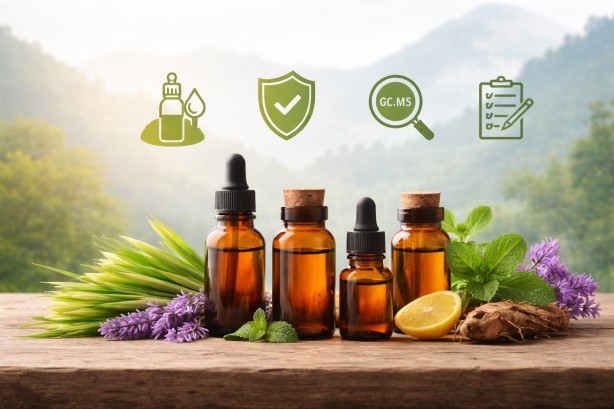
Essential oils are now common in Nepal—diffusers at home, massage oils in spas, herbal balms in pharmacies, and “natural” soaps/shampoos. But they’re also one of the most misunderstood products in the market. This guide explains what essential oils are, how they’re made, how to use them safely, and what matters for quality and export—using Nepal-relevant examples.
1) What is an essential oil?
An essential oil is a highly concentrated aromatic liquid produced by plants and extracted from parts like leaves (lemongrass), berries (sugandha kokila), needles (talispatra), flowers (some species), bark (cinnamon family), roots/rhizomes (jatamansi), etc.
Key idea: essential oils are made of volatile compounds—they evaporate easily and carry the plant’s characteristic smell.
Why “a little goes a long way”: yields are often small. Many plants contain roughly 0.1%–1% essential oil (varies a lot), so 1 kg of oil can require hundreds of kg of plant material in low-yield cases.
2) Essential oil vs mustard oil / coconut oil (common confusion in Nepal)
In Nepal, “oil” usually means edible oils. These are not the same product category.
Edible oils (mustard, soybean, sunflower, ghee, coconut): fatty, non-volatile, used for food and cooking
Essential oils: aromatic, volatile, used for fragrance/wellness, cosmetics, soaps, balms (and sometimes as ingredients in traditional preparations)
A simple practical test:
Edible oils stay greasy and don’t evaporate.
Essential oils smell strong and evaporate faster (though some feel heavier than others).
3) Why do people use essential oils?
People use them mainly for:
Fragrance & home use
Diffusers, room sprays, scented candles, DIY fresheners.Personal care (only when properly diluted)
Hair oil blends, skincare blends, soaps/shampoos.Wellness & aromatherapy routines
Relaxation, sleep routines, stress reduction (aroma-based habits).Household functional uses
Citronella and similar oils are widely associated with insect-repellent products.Traditional balm-style uses
In South Asia (including Nepal), oils like wintergreen are often associated with balm/liniment-style products.
Important: “wellness use” is not the same as “treating a medical condition.” For health problems, medical advice matters.
4) Popular essential oils in Nepal (seen in market + produced locally)
Nepal’s essential oil supply broadly comes from cultivated/farm production and wild/community forest harvesting.
A credible snapshot of commonly traded/produced oils (with botanical names) is listed in an essential-oil stakeholder directory by ANSAB, including: lemongrass, citronella, palmarosa, mentha, wintergreen, sugandha kokila, jatamansi, juniper, and talispatra (Himalayan silver fir).
A) Cultivated / farm-based (easier to scale)
Often grown like crops and distilled:
Lemongrass (Cymbopogon flexuosus)
Citronella (Cymbopogon winterianus)
Palmarosa (Cymbopogon martinii)
Mentha / mint (Mentha arvensis commonly listed)
Chamomile (Matricaria chamomilla) appears in Nepal stakeholder lists though it’s less widespread than the big grasses/mints
B) Wild / forest-based (higher value, higher compliance needs)
Commonly associated with community forests / Himalayan collection:
Wintergreen (Gaultheria fragrantissima)
Sugandha Kokila (Cinnamomum glaucescens)
Juniper (Juniperus indica)
Talispatra / Himalayan silver fir (Abies spectabilis)
Jatamansi / spikenard (Nardostachys jatamansi, listed in CITES literature under Nardostachys grandiflora)
Sunpati / anthopogon (Rhododendron anthopogon) is also sold/marketed as a Himalayan aromatic oil
Sustainability + legal trade note: Some high-value species (notably jatamansi/spikenard) are regulated in international trade and require proper permits/documentation.
5) How essential oils are made in Nepal (step-by-step)
The most common production method in Nepal is steam distillation (also called hydrodistillation in some setups).
Step 1: Harvest & selection
Timing matters—oil yield and aroma profile can shift by season and plant maturity.
Step 2: Pre-processing
Cleaning, chopping/crushing, sometimes partial drying (depends on plant).
Step 3: Distillation (core process)
Steam passes through plant material, carrying volatile compounds into a condenser.
Step 4: Separation
Condensed liquid separates into:
Essential oil
Hydrosol (aromatic water)
Step 5: Filtration + settling (often helpful)
Short resting can improve clarity and “round off” harsh notes for some oils (this is practice-based; exact benefit varies by oil).
6) Why some oils are “better quality” than others
Quality differences usually come from:
Correct botanical identity (wrong plant = wrong oil)
Harvest timing & handling (freshness, drying method, contamination control)
Distillation control (temperature/pressure/time)
Clean separation & storage (oxidation is a big quality killer)
For serious buyers (especially export), producers often use:
GC–MS testing (chemical “fingerprint”) to verify composition and detect adulteration; GC–MS is also used in published essential-oil analyses.
7) Packaging & storage (this decides shelf life)
Even a well-made oil can degrade fast with poor storage.
Best containers
Retail: dark/amber glass
Bulk: aluminum or suitable food-grade containers (industry practice depends on oil type)
Best storage conditions
Cool, dark place
Tight cap (oxygen exposure speeds oxidation)
Avoid heat and direct sunlight
A technical guidance document on essential oils in cosmetics emphasizes storing oils in appropriate containers and away from heat and light, with containers sealed tightly.
Labeling basics (builds trust)
Botanical name
Batch/lot number
Distillation date
Net volume/weight
Origin (district/region)
Safety warnings and intended use (cosmetic/fragrance, etc.)
8) Safe use (must-read)
This is where most real-world harm happens—people use essential oils like edible oils.
Always dilute for skin use
A common personal-use range is 0.5%–2% depending on the person and purpose.
A widely taught rule-of-thumb: 1% ≈ 1 drop per ~5 ml carrier oil (approximation; drop size varies).
Don’t ingest casually
Oral use has real risk (dose, interactions, purity, and regulatory standards matter). If you’re not trained and not using correctly-certified materials, avoid it.
Extra caution needed for
Children
Pregnancy
Asthma/allergies
Pets
Sensitive skin
Wintergreen warning (Nepal-relevant)
Wintergreen oil is extremely high in methyl salicylate (often ~95–99% reported in data sheets/analyses), which is one reason it must be treated with respect.
Translation: don’t apply undiluted; keep away from children; avoid casual “internal use.”
9) Purity check: real vs fake/adulterated oils
Adulteration happens everywhere—cheap solvents, synthetic fragrance, or blending to mimic expensive oils.
Practical signs (not perfect)
Rare oil sold very cheap → suspicious
No origin/batch/producer details → low transparency
Smell feels “perfumey” rather than plant-like → could be synthetic
Strong irritation quickly → may be impure or too concentrated
Best proof for serious use
GC–MS report
COA (Certificate of Analysis)
Traceable producer + batch system
10) Nepal’s essential oil export reality (updated numbers + context)
Trade classification: Essential oils are commonly reported under HS 3301 (essential oils, extracts, related products).
Recent export values vary by source and year, but “few million USD” is realistic for Nepal in recent data:
The Observatory of Economic Complexity reports Nepal’s 2024 essential oil exports at about USD 4.45M, with major destinations including India, the United States, and France.
A report by Kathmandu Post citing Nepal’s Trade and Export Promotion Centre and Department of Customs data reported essential oil exports of Rs 429.66 million in the first ten months of FY 2024/25 (mid-July 2024 to mid-May 2025), and noted a year-on-year drop in that period.
Where Nepal is strong
Diverse Himalayan botanicals and unique aromas
Community forest models and local harvesting knowledge
What limits bigger export growth
Consistency (batch-to-batch chemical profile)
Testing & documentation (GC–MS, COA, traceability)
Packaging + contamination control
Sustainable/legal harvesting compliance, especially for regulated species like jatamansi (CITES-listed).
Strong “Nepal origin” branding backed by verifiable quality
Bonus: A simple “Nepal buyer checklist”
If you’re buying in Nepal (retail or wholesale), ask for:
Botanical name + origin district
Batch number + distillation date
Storage method (kept away from heat/light?)
For expensive oils: GC–MS / COA
For wild oils: proof of legal sourcing (especially for regulated plants)
If you’re looking to buy essential oils in Nepal, you can find selected options on Sewapoint . Look for clear labels (botanical name, batch info, and origin) for better confidence in quality.