Churpi: Himalayan Mountain Cheese, Global Dog Chew
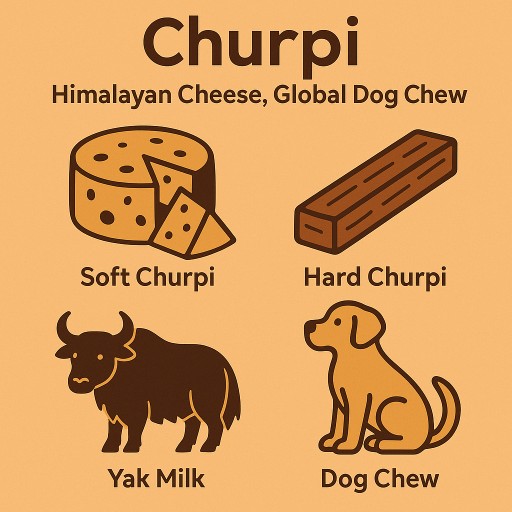
Churpi (also spelled chhurpi or durkha) is a traditional Himalayan cheese that now has two very different lives:
In Nepal and neighbouring highlands, it’s a durable, high-protein food for people.
In global pet markets, it’s sold as a “Himalayan yak chew” for dogs.
This article explains what churpi is, how it’s made, which milk is used, why it becomes so hard, its main types, Nepal’s growing export industry, and how it is consumed abroad.
1. Origins and Basic Idea
Churpi is a fermented, dried cheese from the Himalayan belt (Nepal, Bhutan, and parts of India).
Historically, it was:
A way to preserve surplus milk in cold, remote areas.
A portable, long-lasting food for herders and high-altitude communities.
An energy-dense, protein-rich snack that could last for months without refrigeration.
2. Milk Sources: Yak, Cow, and Buffalo
The milk used for churpi depends on altitude, livestock, and production scale:
Yak milk – common in high Himalayan regions (e.g., Dolpo, Langtang); rich in fat and protein, ideal for cold climates.
Cow milk – dominant in mid-hill and accessible areas; easier to collect in bulk through dairies and cooperatives; widely used in commercial production.
Buffalo milk – important in lower and mid-hill regions; often blended with cow milk.
Modern guidelines in Nepal generally allow churpi from yak, cow, buffalo, or any mixture, reflecting this diversity in practice.
3. How Churpi Is Made
Churpi is essentially concentrated milk protein obtained by curdling and drying.
3.1 Curdling and Draining
Fresh milk is skimmed or churned to remove cream/butter, leaving skimmed milk or buttermilk.
This liquid is heated close to boiling.
The proteins coagulate and separate as curds.
Curds are collected in cloth and hung to drain off the whey.
At this stage, you have a moist curd that is the base for all churpi types.
3.2 Pressing and Drying
For long shelf life and hardness:
The drained curd is pressed to remove more whey and compact the curd.
The pressed blocks are cut into pieces.
These pieces are dried for weeks, either:
Hung near wood-fired stoves (gentle heat and smoke), or
Sun-dried in clean, airy conditions.
The intensity of pressing and length of drying determine whether the final product is soft or very hard.
4. Types of Churpi (Soft vs Hard)
Here is the single, consolidated section on soft and hard churpi.
4.1 Soft Churpi
Soft churpi is made from the drained curd with minimal additional drying.
Texture: moist, crumbly, mildly sour or tangy.
Main use: human food, not a chew.
Common dishes:
Curries and stir-fries
Soups
Dumpling/momo fillings
Chutneys with tomato, chilli, and herbs
It behaves somewhat like rustic cottage cheese or paneer in everyday cooking.
4.2 Hard Churpi
Hard churpi is the same curd taken further through pressing and long drying.
Texture: extremely hard and dense; can take a long time to chew.
Traditional use: slow-chew snack for people, especially herders and villagers.
Modern use: base material for most churpi dog chews exported abroad.
4.3 Modern Variants
Both soft and hard churpi have modern variations, especially on the hard side:
Smoked vs. non-smoked (sun-dried).
High-fat vs. low-fat depending on milk mix.
Flavoured dog chews (turmeric, mint, lemon, etc.).
Puffed churpi pieces—heated until they puff into crunchy treats (mainly pet snacks, sometimes novelty human snacks).
5. Why Hard Churpi Is So Hard
Hard churpi is one of the hardest edible products in the world due to:
Very low moisture: long drying removes most water, extending shelf life and concentrating protein and minerals.
Strong pressing: compresses the casein network and squeezes out gaps, forming a solid block rather than a crumbly cheese.
Prolonged drying and mild smoking: weeks of dehydration (sometimes with smoke) tighten the structure further, making it almost “edible stone”.
Because of this, a small cube can take humans 1–3 hours to slowly chew through.
6. Churpi for People vs Churpi for Dogs
At its core, both are the same type of cheese, but the final design and standards differ.
6.1 Intended Consumer
People:
Soft churpi as a cooking ingredient.
Hard churpi as a slow-chew snack in mountain communities.
Dogs:
Uniform sticks, bars, or nuggets branded as “Himalayan yak chews”.
Marketed as natural, long-lasting pet treats.
6.2 Milk and Supply
Human churpi follows local practice: any mix of yak, cow, or buffalo.
Export chews often rely on:
Yak + cow blends, or
Predominantly cow milk for volume and consistency.
6.3 Texture and Design
Human snacks don’t always push hardness to the extreme.
Dog chews are deliberately made extra hard so dogs can gnaw for a long time.
6.4 Standards and Additives
Export chews must comply with hygiene rules, moisture/protein targets, and labelling laws of importing countries.
Nepal is drafting and refining national churpi standards for quality and branding.
Traditional human churpi is usually just fermented milk with minimal or no added flavouring.
Dog chews are often:
Free from artificial preservatives.
Lightly salted and sometimes coloured/flavoured with natural ingredients like turmeric or herbs.
7. Nepal’s Churpi Industry and Exports
Churpi has developed into a significant value-added dairy export for Nepal.
Produced in multiple hill and mountain districts (eastern to western Nepal).
Made by smallholders, cooperatives, and medium/large dairies alongside ghee, paneer, yoghurt, etc.
Over the last decade, dozens of companies have specialised in churpi dog treats.
Export earnings now reach several billion rupees annually, in some years rivaling established exports like tea.
A large portion of industrial churpi production is now aimed at foreign pet markets rather than local human consumption.
Major export destinations include:
United States (largest market)
Canada
UK and EU countries
Japan, South Korea, Singapore, Hong Kong, Taiwan, Thailand, the Philippines, and other Asian and Latin American markets
8. Consumption Outside Nepal
Outside the Himalayan region, churpi is mostly known as a pet product.
In North America and Europe, “Himalayan yak chews” are sold as:
Natural, high-protein, low-lactose, gluten-free chews.
Alternatives to rawhide.
Sold through big pet chains, online platforms, and specialty shops.
Human consumption abroad remains niche:
Mainly among Himalayan diaspora communities.
Also among food enthusiasts curious about “the world’s hardest cheese”.
9. Quick FAQ-Style Summary
What is churpi?
A fermented, pressed, and dried Himalayan cheese with a very long shelf life.How is it made?
Skimmed/buttermilk is curdled, drained, pressed, and dried (sometimes smoked) until nearly all moisture is gone.Which milk is used?
Yak, cow, buffalo, or mixtures, depending on region and production system.Soft vs hard churpi?
Soft churpi: moist, crumbly, used in cooking.
Hard churpi: very dry, extremely hard, used as a long-chew snack and as the base for dog chews.Why is it so hard?
Very low moisture, strong pressing, and prolonged drying.How do dog chews differ?
Same core cheese, but made extra hard, cut uniformly, and produced under export-quality standards for pets.What about exports?
Nepal now earns billions of rupees annually exporting churpi-based dog chews to North America, Europe, and Asia.